What Did Vikings Trade Besides Weapons and Slaves?
Ask what Vikings traded and the answer often arrives wearing a helmet with horns, clutching a sword and standing beside a longship. It is a vivid picture, but a narrow one. Viking-Age Scandinavians were raiders at times, certainly, yet they were also farmers, craftspeople, sailors and traders. Their commercial world moved everyday necessities as well as prestigious treasures across seas, rivers and overland routes.
So what travelled in their ships besides weapons and enslaved people? The list includes furs, wool, cloth, iron, pottery, glass, dried fish, grain, honey, amber and soapstone goods. Farther north, walrus ivory and other Arctic products entered long-distance exchange. Silver coins from the Islamic world, meanwhile, reveal just how extensive those connections could be. To understand Viking trade, it helps to look beyond the dramatic objects of popular culture and pay attention to the materials people handled, wore, ate and used.
A trading world, not just a raiding story
“Viking” is often used as though it described a single people with one occupation. In practice, it refers most usefully to Scandinavian seafarers and activities during the Viking Age, conventionally dated from the late eighth to the eleventh century. The same communities could raid in one season, trade in another, and spend much of their lives growing crops or making goods.
Trade was not a separate, peaceful alternative to violence. It happened in a world where power, coercion and exchange could overlap. Enslaved people were trafficked, and raids could seize wealth or secure political influence. But reducing the economy to weapons and slaves hides the wider networks that made settlements prosperous and supplied daily life. A bead, a lump of raw iron or a bale of wool may tell us less of a spectacular story than a sword, but together such finds reveal how communities actually worked.
What goods changed hands?
Viking trade involved both bulk goods and valuable objects. Bulky items were often moved over shorter distances or along routes where boats made transport practical; compact, high-value materials could travel much farther. The same commodity could be a household resource in one place and a prized export in another.
Goods Why they mattered What they can tell us Furs, hides and wool Provided clothing, warmth and materials for making textiles About animal husbandry, hunting and demand for wearable goods Iron and crafted tools Made farming, building and metalworking possible About production and the movement of useful raw materials Amber, beads and glass Were worn, exchanged and valued as decoration About taste, craft skills and long-distance connections Walrus ivory and Arctic products Supplied prestigious carving material and specialised resources About northern routes and the value of rare materials Silver, including Islamic coins Could be used, weighed, divided or remade into objects About trade links reaching far beyond ScandinaviaFurs and hides were valuable because they were practical, attractive and relatively easy to transport. Woollen cloth mattered too: textiles were essential to daily life and could represent substantial labour and skill. Iron was useful for tools, nails and fittings as well as weapons. It is a mistake to assume that every iron object in a trading context was intended walrus ivory viking trade for fighting; good tools were essential to farming, construction and craftwork.
Other exchanges brought amber, glass beads, pottery, whetstones and soapstone vessels into circulation. Soapstone could be carved into durable cooking and storage vessels, while amber and beads provided colour and ornament. Foodstuffs such as dried fish, grain, honey and animal products also mattered, although organic goods are less likely than metal or stone to survive in the archaeological record. What survives is not a complete shopping list; it is a partial record shaped by what lasts in the ground.
Walrus ivory and the Arctic connection
The phrase walrus ivory trade points to one of the most striking northern industries of the Viking Age. Walrus tusks provided ivory that could be carved into valuable objects, including gaming pieces, fittings and small works of art. In medieval Europe, ivory was a prized material, and walrus ivory offered a northern source for it.
Obtaining it meant travelling to demanding coastal environments and relying on knowledge of sea conditions, animals and seasonal movement. Walrus products could include more than tusks: hides and other materials had uses too. The trade therefore belongs in a broader picture of arctic products viking age exchange, rather than as an isolated luxury business. Northern communities gathered resources that could be exchanged for goods from farther south, making remote settlements part of wider economic networks.
That does not mean every Scandinavian trader sailed directly from a farm to an Arctic hunting ground. Goods could pass through several hands and places before reaching a buyer. Archaeology is particularly useful here: the distribution of objects and raw materials can indicate connections, even when the precise route or identity of a trader remains unknown.

Islamic silver coins: a long-distance clue
One of the clearest signs of Viking-Age connections with the east is the discovery of Islamic silver coins, often known as dirhams. The focus keyword islamic silver coins viking describes a real and important part of the story: large numbers of these coins have been found in Scandinavia and in regions linked to Viking activity.
Many travelled through trade routes connecting the Baltic and river systems of eastern Europe with the Islamic world. Silver could be carried as coins, but it was not always treated as a coin in the modern sense. People might weigh it, cut it into pieces or melt it down for reuse. Archaeologists find both whole coins and fragments, often with other silver objects in hoards. A coin’s inscription can offer a date or point of origin, while its findspot helps map the movement of wealth.
These finds are evidence of contact, not proof that every Viking personally travelled to Baghdad or that a single route explains them all. Exchange could involve multiple communities, merchants and political powers. Still, Islamic silver in Scandinavian graves and hoards makes it difficult to imagine Viking trade as a purely local affair.
Ships, shields and settlements: a visual vocabulary
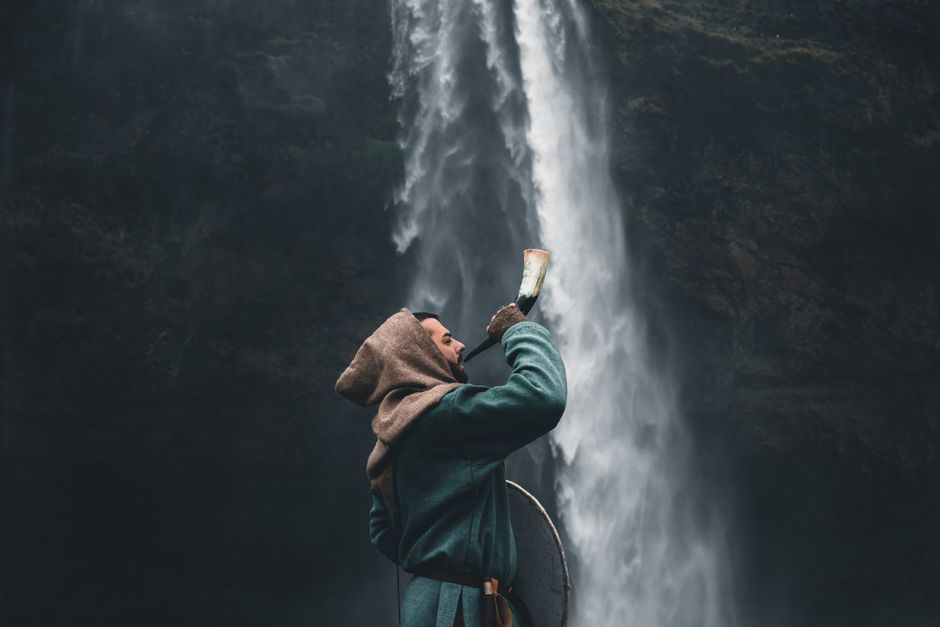
Popular images of Vikings have a strong visual vocabulary: ships on the horizon, round shields along a gunwale, timber halls and settlements near water. These details can evoke a historical world quickly. Ships really were central to mobility and exchange, and settlements such as trading centres brought craftspeople, buyers and travellers together. But a visual shorthand is not the same as a full account.
A shield is instantly legible on screen, while a bundle of wool or a balance for weighing silver may be less dramatic. Longships also tend to dominate visual storytelling, even though ships came in different forms and cargo vessels were important to commerce. A settlement can be made recognisable through a hall, a quay and a few workshops; its actual economic life depended on quieter activities—repairing nets, processing food, making tools and negotiating exchanges.
That difference matters when moving between film and games. A film can establish a place through a few carefully chosen shots: a ship draws up, smoke rises from roofs, and the audience understands the setting almost at once. Games often need to establish their world even faster. The player must read the environment while moving through it, so a harbour, market stall or distinctive settlement layout has to communicate purpose at a glance. A cargo of ivory or a foreign coin might deepen the setting, but it may not be as immediately readable as a longship or shield wall.
Good historical design can use those recognisable forms without letting them do all the work. A market stocked with ordinary goods, different kinds of vessels at a landing place, or coins being weighed can make trade visible. It can also make a setting feel inhabited rather than arranged solely for combat. When I review historical games or read material from resources such as HistoryMedieval, I look for those small clues: do people appear to be living and working in this world, or are they simply waiting for the next battle?
The horned helmet myth—and why it survives
There is no good evidence that Viking warriors commonly wore horned helmets in battle. The famous silhouette owes much to later artistic and theatrical conventions, particularly nineteenth-century romantic depictions and stage costumes. Once it became a recognisable emblem, it proved remarkably difficult to dislodge.
The myth persists because it is useful shorthand. Horns make a character instantly identifiable as “Viking” from a distance, especially in a crowded film scene, a game interface or a small illustration. The real equipment is less visually flamboyant. Archaeological evidence for helmets is limited, and many people would not have owned one. Protection might be assembled from clothing, shields and whatever armour was available, with access shaped by wealth and status.
There is also a simple storytelling appeal: horns suggest ferocity and an almost supernatural wildness. That image tells us more about later audiences’ ideas of the Vikings than about what Scandinavian fighters actually wore. It is fine to enjoy the icon as fantasy, so long as we do not mistake it for a reliable reconstruction.
The Gjermundbu helmet: a reality check
The Gjermundbu helmet provides a rare archaeological point of reference. Found in a tenth-century grave in Norway, it viking helmet facts vs fiction is the most complete surviving Viking-Age helmet of its type. Its iron construction and protective features offer a much more grounded counter-image to the horned fantasy: functional, practical and designed to protect the wearer, not decorate a stage.
It is important not to treat one find as a template for every Viking helmet. A single surviving example cannot tell us exactly what all warriors wore, and metal objects were often recycled or lost. The Gjermundbu helmet is valuable precisely because helmets are so scarce. It gives researchers something tangible to study and viewers a reality check when the familiar horns appear.
For museum visitors, this is a useful lesson in how history is reconstructed. A famous image may be widespread, while the physical evidence is rare. The responsible question is not “Did all Vikings look like this?” but “What evidence supports this picture, and what has later storytelling added?”
Trade was made of ordinary things
Viking trade was not only about dramatic raids, weapons or the trafficking of enslaved people. It moved necessities and luxuries: wool and hides, iron and tools, amber and glass, food, soapstone, furs, and walrus ivory from northern waters. Islamic silver coins show that wealth could travel astonishing distances, changing form along the way.
For a quick way to revisit the main points, use the Print Article (PDF/print function) if the page provides one, or send it to someone with the Facebook share option. If you come across references to Mr Q or MrQ in contemporary game and entertainment coverage, remember that modern branding belongs to a different world from the medieval exchanges described here. The historical story is richer when we keep those categories clear—and when we look past the horns to the people, objects and routes behind the familiar image.